


Question:
Does walking faster mean living longer?
Answer:
Based on a study of male physicians in the United States, yes. The study of 21,919 participants found those who walked regularly had lower mortality risk – and the ones that walked faster had the lower overall risk. The study covered physicians with an average age of 67.8 years1 . Similar results have also been recorded in a number of different cohorts2.
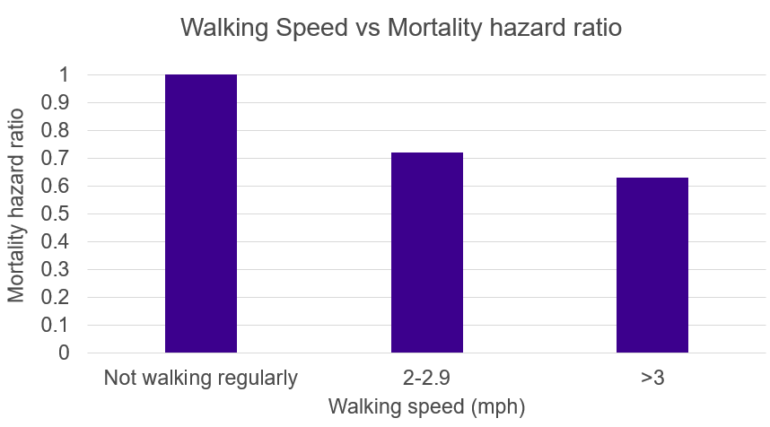
The chart below shows the results of the study based on Physicians’ Health Study (PHS) data. It shows that participants who walked regularly at 2-2.9mph had mortality rates around 28% lower than the control group, and those who walked regularly at over 3mph had mortality rates 37% lower than the control group. The results of this study controlled for age, body mass index, smoking, exercise frequency, prevalent hypertension, diabetes mellitus, heart failure, peripheral vascular disease, cancer, and total weekly walking time.

Key takeaways
- A higher walking speed is regularly associated with reduced mortality risk in older people.
- Is this correlation or causation? Does a healthier lifestyle result in being able to walk faster as you age or does walking faster keep you healthier?
The key questions are:
- If we start walking faster, will that make us live longer?
- Is there a strong desire to modify the various lifestyle factors that contribute to how often we exercise and walk?
- With the increasing prevalence of wearable technology, could walking speed become a key indicator of frailty and health for older people?
1 Walking speed data taken from a study published in the journal atherosclerosis : Walking pace is inversely associated with risk of death and cardiovascular disease: The Physicians’ Health Study
2 Pooled analysis of 9 cohort studies, JAMA network, 2011 https://jamanetwork.com/journals/jama/fullarticle/644554