


Question:
What proportion of adults are obese in Club Vita’s key geographies and how has this changed over time?
Answer:
The proportion of adults who are obese (defined as having a Body Mass Index over 30) has been persistently increasing over the last 30 years in the UK, US and Canada. In 2022, these proportions reached 27% in Canada, 29% in the UK and 43% in the US. Obesity rates in Germany, the Netherlands and Switzerland have also increased over this period, but these increases have almost flattened out since around 2008. The chart below shows these rates over time.

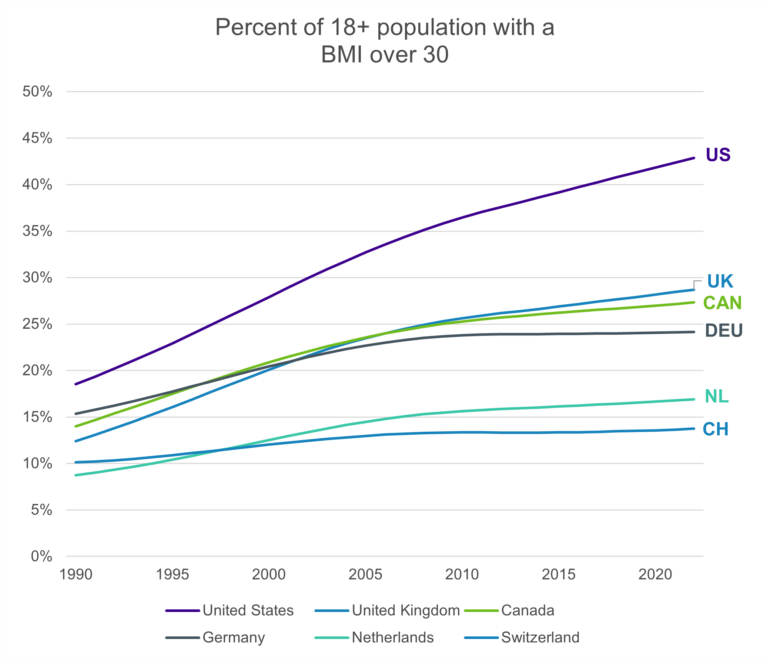
Source: Data downloaded from Our World in Data Feb 2026 (original source WHO).
Key takeaways
- Obesity rates in the UK, US and Canada have been increasing for decades reaching levels in 2022 of 27% in Canada, 29% in the UK and 43% in the US.
- With obesity a key risk factor for morbidity and mortality, these increases are of key importance to longevity stakeholders.
- How will the increasing availability and accessibility of anti-obesity medications change this trend in the future? Dial in to our upcoming webinar (sign up details below) to find out more!
Obesity is associated with an increased risk of a wide range health conditions. The Global Burden of Disease Study (2024) estimated that in 2021 high BMI caused around 3.7m deaths globally from non-communicable diseases (such as cardiovascular, diabetes and cancers). And a study published in February 2026 in the Lancet found that people with obesity are 70% more likely to be hospitalized or die from infection. However, over the last few years both availability and accessibility of pharmaceutical interventions, such as GLP-1 and GIP receptor agonists, aimed at weight loss have significantly increased.
The key questions for longevity stakeholders in the UK, US and Canada are:
- How will obesity rates change in the future?
- Will the growing availability and accessibility of anti-obesity medications lead to significant longevity improvements in the future?
- Will any long-term effects of these medications have negative impacts on health?