


Question:
Are adults in Canada, the US and UK getting enough sleep?
Answer:
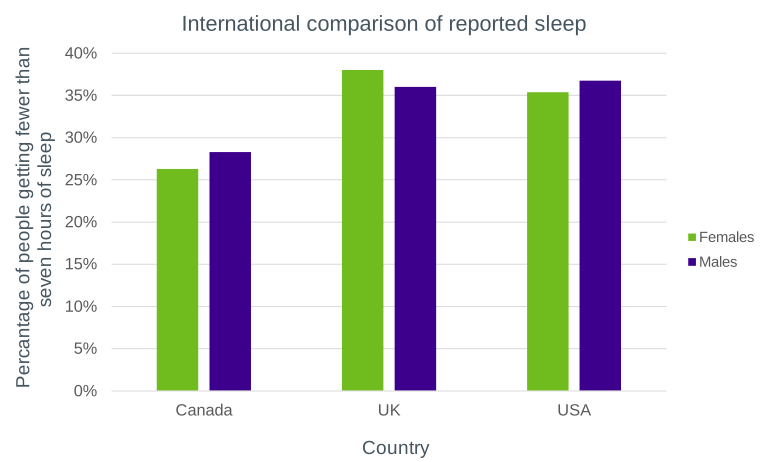
Governments in all three countries recommend between 7 to 9 hours of sleep for adults (more for children and less for the elderly). Survey data from each country shows that between 26% and 38% of people are failing to reach that level.
Our research shows that adults in the UK are more likely to report inadequate sleep than their counterparts in North America. Conversely, adults in Canada appear to be the best slept. The chart below shows the percentage of males and females in each country who report getting fewer than seven hours of sleep.1,2,3,4

1 Canadian sleep data taken from the 2020 CCHS survey compiled by Statistics Canada: Sleep behaviours among Canadian adults: Findings from the 2020 Canadian Community Health Survey healthy living rapid response module
2 US data sourced from the CDC Behavioral Risk Factor Surveillance System (BRFSS), 2022. FastStats: Sleep in Adults | Sleep | CDC
3 UK data was sourced from the YouGov 2022 Sleep https://yougov.com/en-gb/articles/42957-yougov-sleep-study (ONS data was unavailable)
4 The studies and surveys used all had differing sample sizes and methodologies. They were conducted over slightly different time periods and contained different combinations of region, gender, age and occupation. All studies relied upon self reported results and routines which are inherently subjective in nature. Different surveys will likely show different rates of sleep disturbances and disorders.
The chart above shows that adults in the UK and the US are the least likely to meet sleep guidelines. UK females and US males in particular are struggling to get sufficient sleep. Conversely, Canadians appear to be the best slept. We also observe that males in North America are less likely than females to get at least seven hours of sleep nightly.
The Canadian Community Health Survey (CCHS) also contains interesting socioeconomic data. The results showed that while the top quintile of income earners were more likely to meet sleep guidelines, the reported mean number of hours of sleep among individuals in the lowest quintile was higher1. Furthermore, the data demonstrate that Canadians and British citizens aged 65 and above are less likely than their younger counterparts to get sufficient sleep. Conversely, Americans aged 65 and above are more likely to report at least seven hours of sleep compared to younger Americans.1,2,3
Survey data from YouGov reveals that between 59%-68% of adults report having difficulty falling asleep. Again, Canadians reported better results with 59% of adults agreeing that falling asleep is difficult. The share of people in the US and the UK reporting difficulty falling asleep was 67% and 68%, respectively. Chronic insomnia is also a major concern. Surveys in Canada, the US and UK show that between one-twelfth and one sixth of people have been diagnosed with clinical insomnia. The problem is worse in North America, where 13% of Canadians and 15% of Americans have been diagnosed with clinical insomnia.
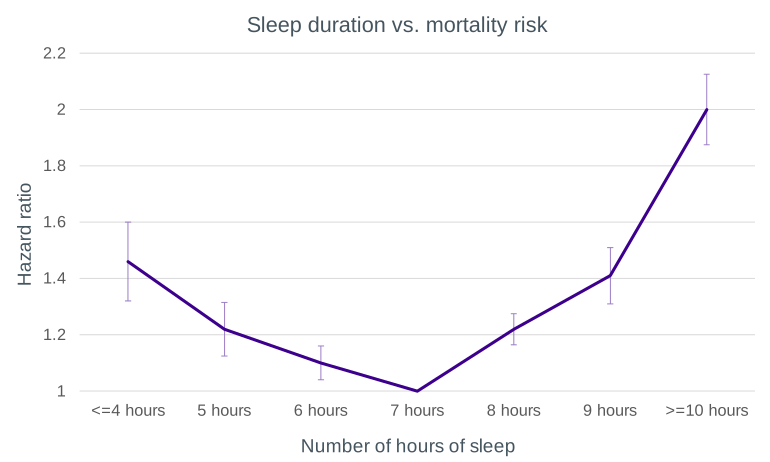
The chart below shows the connection between sleep duration and mortality.5
5 Association of sleep duration with all-cause and disease-specific mortality in US adults | Journal of Epidemiology & Community Health. Yang L, Xi B, Zhao M, et al Association of sleep duration with all-cause and disease-specific mortality in US adultsJ Epidemiol Community Health 2021;75:556-561.
The study from which this data was taken treated seven hours of sleep as the “optimal” baseline number of hours. As one would expect, people who regularly get four hours or less of sleep experienced higher (by 46%) all-cause mortality. The U-shaped curve shows that getting either too much or too little sleep is associated with elevated mortality risk. Amazingly, the highest mortality risk is seen with excessive sleep which is defined as 10 or more hours of sleep (8-9 hours is defined as “extended sleep”, 7 as “optimal”, and <7 as “insufficient”). However, the causal connection is open to interpretation. Do extended and excessive sleep cause ill-health and higher mortality? Or do individuals in poorer health tend to sleep more? Whether these findings raise questions about the need to refine government sleep guidelines (currently 7-9 hours for working age adults), will depend on the answer to this causality question.
The study reported similar hazard ratios for specific causes of death such as cancer and cardiovascular disease. These results are aligned with established medical knowledge linking insufficient sleep to a variety of health problems including, but not limited to, reduced cognitive functioning, cardiovascular disease, diabetes, depression, and reduced immune function.1,5
Key takeaways
- Between one quarter and two fifths of adults in Canada, the US and UK report getting insufficient sleep.
- Most adults in all three countries report difficulty falling asleep.
- Insomnia rates are elevated in all three countries and show no signs of improving.
- Data in Canada and the US show different patterns among adults aged 65 and above. Canadian and British retirees are less likely to meet sleep guidelines while American adults aged 65+ are more likely to report adequate sleep.
- Research shows a correlation between higher mortality and both getting too much and too little sleep.
The key questions are:
- Why is the share the adults getting insufficient sleep so high in all three countries?
- Is there a strong desire to modify the various lifestyle factors that contribute to the quantity and quality of sleep we get?
- Will a major medical breakthrough dramatically reduce the incidence of insomnia and sleep apnea?
- Modern technology can be used to track sleep while also serving as a distraction and hindering sleep. Is the overall net impact of technology on sleep positive or negative?
- How will sleep patterns and habits influence future longevity outcomes among different age groups and socio-economic classes?