


Question:
Can alternative factors such as occupation, postal code, and spousal information replace the predictive value of gender data in pension plan mortality modelling?
Answer:
Not entirely. Club Vita's research paper, The Value in Pension Plans Using Gender Data, found that mortality models become less accurate when gender is removed, even when additional demographic factors are incorporated. As a result, uncertainty increases when measuring pension liabilities and managing longevity risk. The paper was developed in collaboration with OPTrust, administrator of the Ontario Public Service Employees Union (OPSEU) Pension Plan, and Eckler, in response to growing questions around the collection and use of gender data in pension plans.
Figure 1 compares the performance of basic mortality models with and without gender as a predictive factor. The gender-specific model provides a closer fit to actual mortality experience across Canadian DB pension plans.

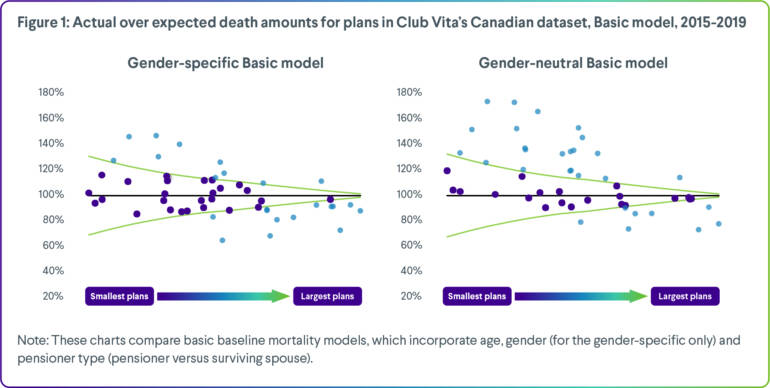
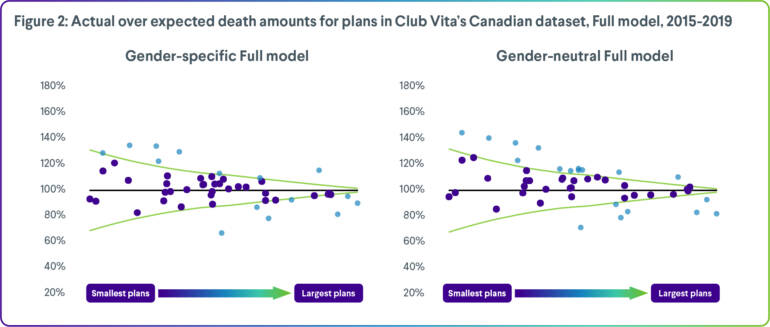
Figure 2 compares more detailed mortality models that incorporate additional demographic characteristics. While the gender-neutral model uses spouse age difference as a proxy for gender, the gender-specific model continues to provide a more accurate fit to actual mortality experience.
Key takeaways:
- Gender-specific models provide the best fit to actual experience. More pension plans fall within the expected range when gender is included as a predictor, indicating a stronger ability to explain differences in longevity across plans.
- Alternative demographic factors help, but do not fully close the gap. Occupation, postal code, and spousal information improve gender-neutral models, but significant variability remains. Gender continues to provide information that is not fully captured by other factors.
- Less accurate mortality models can translate into increased longevity measurement and funding risk. For most plans in our analysis, moving to a gender-neutral approach resulted in absolute liability changes ranging from 0% to 6%. For the OPSEU Pension Plan specifically, using gender-neutral assumptions would have understated total liabilities by approximately 1.0% (approximately $270 million).
The key questions are:
- Are pension plans, insurers, and regulators aware of the increased measurement risk they would be exposed to in the absence of gender data?
- How should pension plans balance predictive accuracy, privacy considerations, and inclusivity?