


14 January 2026
Question:
Provisional 2025 England & Wales mortality rates look broadly in line with pre-COVID expectations. However, predictions for the rest of this decade are much weaker than they were pre-COVID. Has the CMI model overreacted to the pandemic?
Answer:
In our recent webinar on the CMI model, we were posed an interesting question. We presented a version of the chart below. An attendee observed that the post-COVID trend gives a significantly higher prediction for mortality in 2030 than what we might have expected pre-COVID. However, 2024 was conspicuously light versus the post-COVID trend. In addition, significant further improvements were expected for 2025.
The CMI_2024 projection doesn’t track 2024 experience more closely because of the heavy mortality we saw in 2023. In simple terms, the model splits the difference between the 2023 and 2024 data points when smoothing through the observed data.
To help illustrate this point, we’ve added a provisional 2025 value to our original chart. It falls broadly in line with what we might have expected pre-COVID .
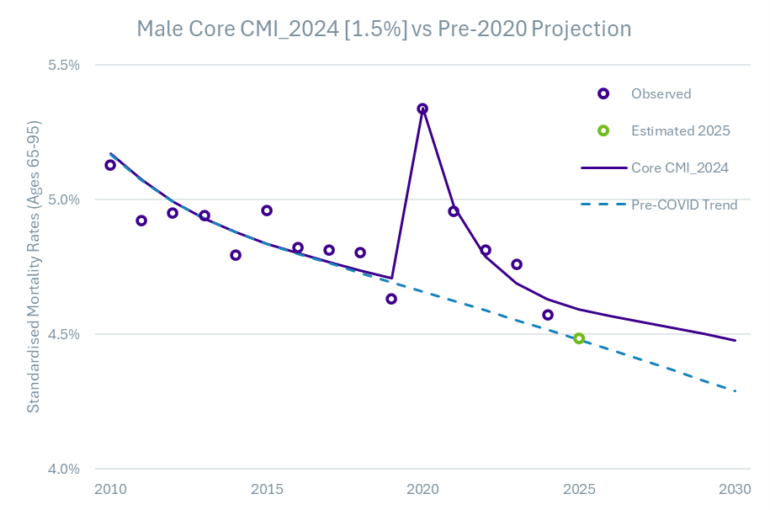
Blue line shows core male CMI_2024 [1.5%] but calibrated to 1979-2019 data. Purple line shows core CMI_2024 [1.5%]. Green dot is an illustrative estimate based on weekly ONS data published up until 14 January 2026.
Based on this analysis, we agree that the CMI_2024 projection looks weak in the context of the provisional 2025 data. Under that projection. Provisional mortality for 2025 is only slightly heavier than the projected value for 2030 under CMI_2024.
So what does this mean for users of the core CMI model?
Expected strengthening of projection under CMI_2025
CMI_2025, which will allow for the finalised 2025 data, will be published in the spring. The new model’s core projection is likely to fall around halfway between the purple and blue lines shown above . This would equate to an 0.7% increase in cohort life expectancies1 from age 65.
We show what CMI_2025 might look like below.
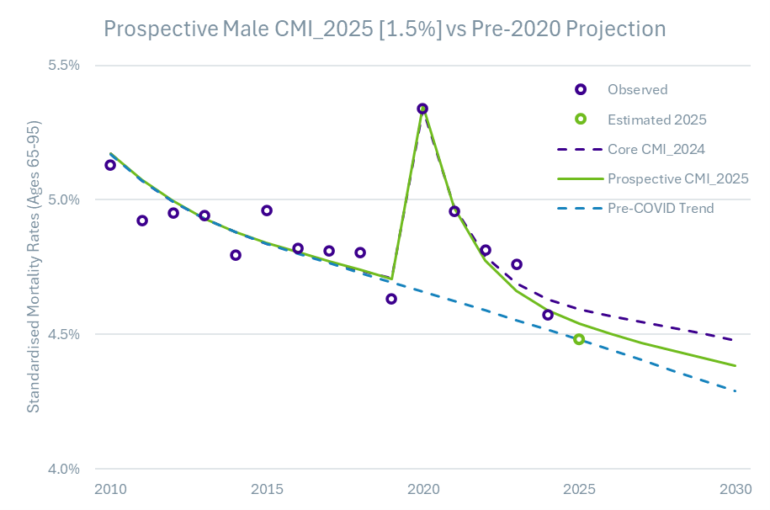
Green line shows a CMI_2024 [1.5%] but calibrated to 1985-2025 data, with preliminary 2025 being 2% lighter than 2024 (as illustrated by the green dot).
Importance of monitoring emerging experience for 2026
Should 2026 mortality also fall in line with pre-COVID expectations , we should expect to see further strengthening of the projection in the CMI_2026 edition. Mortality rates throughout the rest of the decade would then be projected to come close to pre-COVID expectations. This would equate to a further 0.6% increase in cohort life expectancies from age 65.
Of course, 2026 could turn out to be significantly heavier or lighter than this. We are in a period where we have limited “signal” on post-COVID mortality improvement trends. Each new data point is crucial. It affects both how the CMI model mechanistically processes the data and how we interpret the resulting projection.
Key takeaways:
- Users of the CMI_2025 model can expect to see increases in liabilities compared to CMI_2024 and other recent editions.
- Depending on how 2026 emerges, further liability increases could be on the horizon.
- As we emerge from the pandemic, each added year of data is crucial to both how the CMI model processes the data and how we interpret the resulting projections.
1 See https://www.clubvita.net/glossary/cohort-life-expectancy. Changes in cohort life expectancy represent a useful proxy measure for changes in pension plan liabilities.

Amy Walker
Club Vita
Actuary and Client Delivery Lead

Erik Pickett
Club Vita
Actuary and Chief Content Officer

Nick Chadwick
Club Vita
Longevity Specialist